

The Divine Web Within:
Understanding Bio-Tensegrity
Most of us grew up with a very “hardware store” understanding of the body.
Bones are the beams.
Muscles are the pulleys.
Joints are the hinges.
We imagine ourselves as walking stacks of rigid parts, held together by effort and willpower… which might explain why so many people move through life feeling stiff, compressed, and one bad sneeze away from a visit to the chiropractor.
But what if your body isn’t a pile of parts?
What if it’s a living, responsive tension network — a graceful, intelligent system designed for fluid motion, not mechanical strain?
Welcome to the world of bio-tensegrity.
From Architecture to Anatomy
The concept of tensegrity was popularized by architect and futurist Buckminster Fuller. In tensegrity structures, rigid pieces don’t stack on top of each other. Instead, they “float” inside a continuous web of tension.
Stability comes not from compression alone, but from balanced tension distributed throughout the whole system.
Sound familiar? It should. That’s your body.
Bones Don’t Stack — They Float
In the traditional mechanical model, bones are seen as the main stabilizers. Muscles just pull on them like ropes on a lever.
But in the bio-tensegrity model, bones are actually more like spacers suspended within a continuous web of tension-bearing tissues:
- Fascia
- Tendons
- Ligaments
- Muscles
This soft-tissue web holds everything in relationship. The bones don’t jam downward under gravity — they are supported from all directions at once.
That means:
- Stability doesn’t come from rigidity
- Strength doesn’t come from bracing
- Movement doesn’t come from isolated muscle force
Instead, it comes from whole-body tension harmony. Now that’s a design worthy of the Universe.
Fascia: The Great Communicator
Here’s where things get magical.
Fascia is not just packing material. It is a living sensory organ that wraps every muscle, bone, nerve, and organ. It forms one continuous matrix from the top of your head to the soles of your feet.
Think of fascia as:
 A spider web
 A fluid transmission system
 A communication network
When you move one part of your body, the fascia distributes that force through the entire system. That’s why:
- Tight hips can affect your shoulders
- Jaw tension can influence your posture
- Ankle restrictions can alter your neck
Nothing in you moves alone.
Fascia constantly adjusts tension like an orchestra conductor, coordinating how bones are positioned in space as muscles contract and release. It stores elastic energy, absorbs shock, and smooths transitions between movements.
That’s why healthy fascia makes movement feel:
 Effortless
Springy
Graceful
Connected
When fascia is dehydrated, scarred, or stuck in protective tension patterns, movement becomes:
 Jerky
Jerky
Compressed
Painful
Fatiguing
The issue isn’t just strength — it’s communication.
Protection Through Connection
Bio-tensegrity also explains how your body protects itself.
Because tension is distributed throughout the entire system, impact forces don’t localize to a single joint or tissue. Instead, they spread across the fascial web. This protects:
- Organs
- Joints
- Muscles
- Nervous system structures
Your fascia is like a full-body shock absorber and support net working 24/7 without asking for applause.
(It deserves applause, by the way.)
Movement Becomes a Wave, Not a Strain
When fascia is healthy and hydrated, movement flows as a wave through the system rather than a series of disconnected muscle contractions.
This is why practices like:
- Qigong
- Tai Chi
- Yoga
Elastic, spiral-based movement feels so different from rigid exercise. They restore the system’s tensional balance, re-educating the fascia to distribute force efficiently again.
You’re not “working harder.”
You’re working more intelligently with your design.
The Big Takeaway
You are not a stack of parts trying to hold yourself together.
You are a living tensegrity structure — a responsive, adaptive web of communication and support.
Your bones float.
Your fascia listens.
Your movement is meant to ripple, not grind.
When we release unnecessary tension and restore fascial glide, we don’t just become more flexible.
We become more integrated.
And integration… is freedom.
Feel Your Inner Tensegrity: A Simple Qigong Practice
Understanding bio-tensegrity is helpful…
Feeling it in your own body is transformational.
Here is a gentle Qigong exercise to awaken your fascial network and sense how your body moves as one connected system.
Exercise: The Floating Skeleton
Purpose:
To experience how bones are suspended in a web of living tension, rather than stacked under pressure.
 Set Your Structure
Stand with your feet shoulder-width apart.
Knees soft.
Spine long, but not stiff.
Arms relaxed at your sides.
Imagine your body is gently suspended from above, like a marionette held by threads of light — not rigid, just buoyant.
Take a slow breath in through the nose…
Long breath out through the mouth.
 Sense the Web
Bring your awareness to the space between your joints.
Instead of feeling your bones pressing downward, imagine them floating in a soft, elastic web beneath your skin.
Picture this web extending:
- From head to toes
- From left hand to right foot
- From your spine into your arms
You are not held up by effort; you are suspended by connection.
 Add Gentle Movement
Slowly raise your arms forward as if lifting a large, weightless ball.
Move very slowly.
As your arms rise, notice:
- Your chest subtly responds
- Your back widening
- Your hips adjusting
- Your weight shifts through your feet
Even though only your arms are moving, your whole body reorganizes.
That’s bio-tensegrity in motion.
Pause briefly at shoulder height…
Then slowly lower the arms.
Repeat 3–5 times.
 Feel the Rebound
Now gently bend your knees just a little… then straighten.
Not a squat — just a soft pulse.
See if you can feel a springy rebound through the body, like a quiet wave moving upward through a connected fabric.
That elastic responsiveness is your fascia storing and releasing energy — your built-in movement intelligence.
 Closing Awareness
Stand still again.
Notice:
- Do you feel taller without trying?
- Lighter?
- More evenly balanced?
That’s what happens when tension is distributed, not forced.
Your body doesn’t need to be held together.
It needs to be allowed to organize itself.
That is the wisdom of fascia.
That is the principle of bio-tensegrity.
And that is the feeling of moving from fracture to freedom.
 Follow-Up Practice: Spirals of Freedom
If the first exercise helped you feel your body as a connected web, this one helps you feel how that web is designed to move — in spirals.
Straight lines are mechanical.
Spirals are biological.
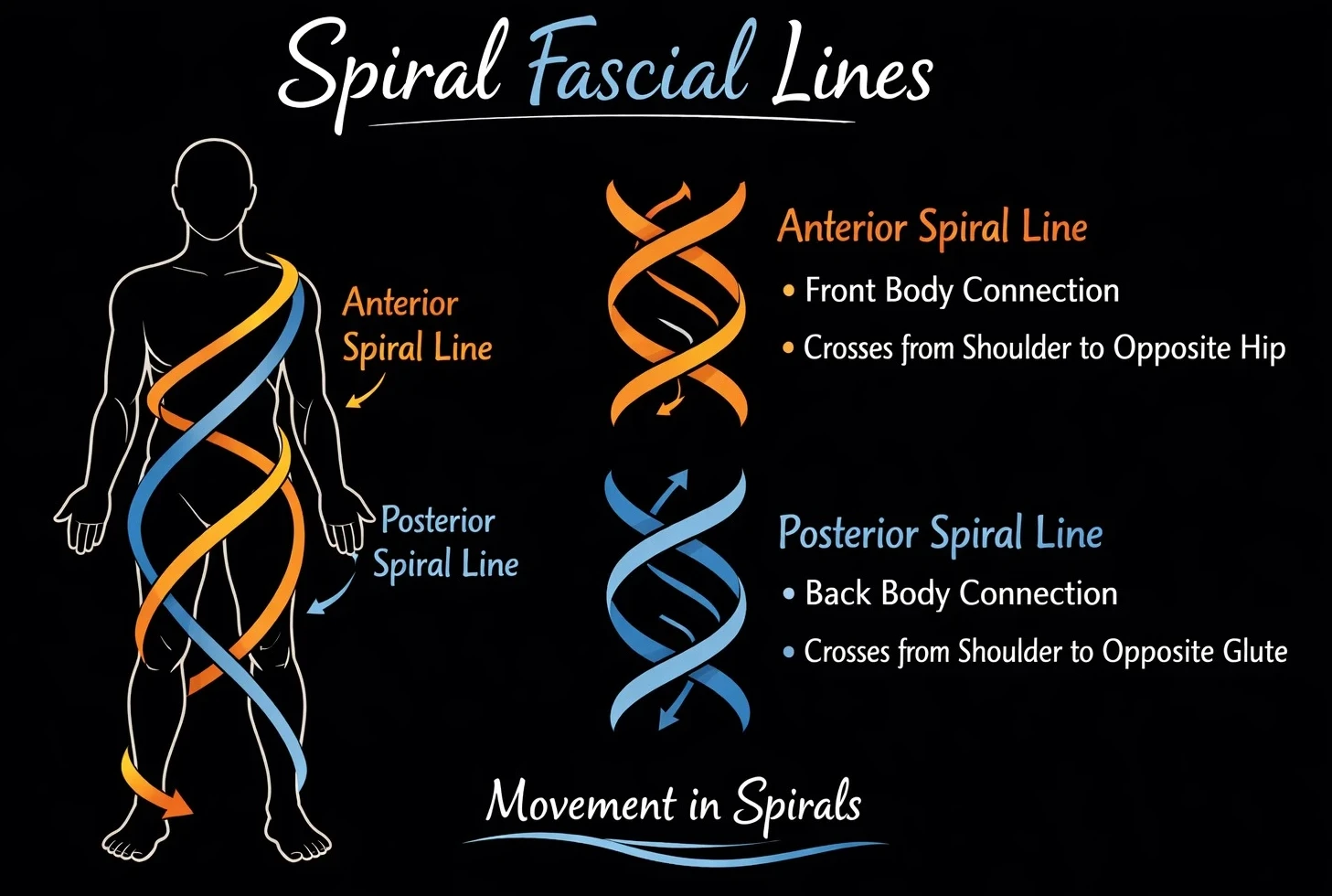
Your fascia wraps around you in helical patterns, like living ribbons. When you move in spirals, you awaken the body’s natural elastic intelligence.
Exercise: Silk-Reeling Spirals
Purpose:
To restore fluid communication through the fascial network using gentle rotational movement.
Return to Your Base
Stand as before:
Feet shoulder-width
Knees soft
Spine long and easy
Imagine again that your bones are floating in a soft, responsive web.
Take one slow breath in…
and out.
Begin a Small Spiral
Let your right hand float forward at chest height, palm facing inward.
Now begin to draw a small, slow circle in the air with your hand.
But here’s the key…
Don’t just move the hand.
Let the motion ripple:
- Wrist soft
- Elbow follows
- Shoulder rotates
- Chest gently turns
- Spine subtly spirals
- Weight shifts across the feet
The movement is not isolated.
It travels through the fascial web.
Small circle. Slow. Continuous. Like you are reeling silk from a cocoon.
After several circles, reverse the direction.
Then switch to the left hand.
Feel the Cross-Body Connection
Now make the circles slightly larger and allow the opposite hip to subtly respond.
Right hand circles → left hip softens
Left hand circles → right hip responds
You are now feeling cross-body fascial lines engaging — the same lines that let you walk, throw, and turn with efficiency and grace.
Nothing is forced.
Everything is connected.
Spiral Through the Spine
Let both arms float in front of you as if holding a large beach ball.
Now gently rotate your torso left… center… right… center…
But instead of turning like a stiff robot, imagine your spine as a spiraling river.
The head floats last.
The hips respond softly.
The knees remain springy.
You are wringing out tension, not cranking your joints.
This spiral motion hydrates fascia, distributes force, and reminds your nervous system that movement can be smooth and safe.
Closing Integration
Let your arms rest at your sides.
Stand quietly for a moment and notice:
• Do you feel warmer?
• Looser?
• More coordinated without trying?
That is the fascial network waking up and communicating again.
Spirals restore the body’s original design — where movement flows through the whole system like a wave through water.
When we move in spirals, we stop fighting gravity and start dancing with it.
That is bio-tensegrity in motion.
That is fascia in conversation.
And that is another step on the journey from fractured… to freedom.
I found this an incredibly captivating read! I’ve always been interested in how our bodies connect on a deeper level. The way fascia, bio-tensegrity, and fluid movement interact really clarifies aspects of posture and flexibility that I’ve struggled to understand.
I’m curious, do you have any practical exercises or daily movements you would recommend for someone who is just starting to explore fascia and bio-tensegrity? I would love to see how these concepts can be applied in everyday life.
Thanks, Alysanna, for reading and commenting on the article!
Yes, I do have exercises that I prescribe to my clients. I’m working on the YouTube video for them, which should be ready next week. I’ll post the link here when it’s finished. Thanks again and keep on thriving!????????????
I’ve long been intrigued by the notion that the body operates as more than a set of individual muscles and joints acting independently, and this really helped clarify that perspective for me. The explanation of fascia, bio-tensegrity, and fluid movement highlights how the body works as a unified, interconnected system rather than a series of separate components, which strongly aligns with what I’ve personally noticed.
It especially clarified aspects of posture and flexibility that I’ve struggled to understand in the past. Instead of thinking about stiffness or imbalance as a single problem area, the perspective of tension distribution throughout the whole body offers a much more intuitive explanation. It helped me see why certain stretches or strengthening exercises sometimes didn’t produce the results I expected, and why movement quality can matter just as much as movement quantity.
What stood out most was how empowering this understanding feels. Recognizing that small adjustments in alignment, breath, and movement patterns can influence the entire system gives me a renewed sense of curiosity about how I move every day. It’s not just informative—it changes the way I think about my body and opens the door to more mindful, sustainable ways of improving mobility and comfort.
I’m glad you found the information helpful and you resonated with it, Pauline! Thank you and keep on thriving!
This is a beautifully articulated and conceptually accurate explanation of bio-tensegrity, translating a complex anatomical principle into accessible and experiential language. Your integration of fascial science with movement practices like Qigong and spiral dynamics reflects a strong understanding of how tension distribution, elasticity, and neuromuscular coordination truly function. I especially appreciate the emphasis on whole-body integration over isolated muscle mechanics, which aligns with current fascia research and functional movement models. The guided exercises effectively bridge theory and embodiment, making the science not only understandable but directly applicable.
Thank you, Kavitha, for reading and responding. I’m thrilled you resonated with the article!
Keep on thriving!!
Al
This was a fascinating read. The shift from seeing the body as stacked parts to a living tension network truly reshapes how we understand movement and stability. The explanation of fascia as a communication system was particularly insightful. I also appreciated the practical Qigong exercises. They make the concept tangible. How might everyday movement habits change if more people understood their bodies through this bio-tensegrity lens?
Thanks, Muyivu, for reading and responding to the article!
Yes, if people understood how our bodies move through space, it would be helpful to enhance each of our well-beings!
Keep on thriving!
Al
Our bodies are definitely not just a pile of parts, and it is a miracle how everything works together so effortlessly, well most of the time. But when things go wrong or are unbalanced, then you know about it.
It’s funny how Fascia is only coming to the fore recently, as nobody ever mentioned the fascia when something goes wrong, but a lot of the time just working on the fascia can sort problems out.
Thank you for the lovely examples of exercises that we can try to rebalance our systems.
Thanks, Michel, for your thoughtful response.
I hope you find the exercises helpful!
Keep on thriving!
This article opens up a fascinating discussion about how fascia the connective tissue that surrounds muscles and organs plays a crucial role in movement, stability, and overall body function. The concept of **bio‑tensegrity** is especially interesting because it shifts how we think about the body: instead of seeing bones and muscles as separate parts, it shows how tension and compression are balanced throughout the entire system, much like an architectural tensegrity structure.
Talking about movement this way challenges the traditional view of the body as levers and pulleys and instead emphasizes fluidity and interconnectedness. It makes sense that when fascia is healthy hydrated, flexible, and free of adhesions movement feels smoother and more efficient, and pain or stiffness tends to decrease.
This kind of perspective encourages us to think beyond isolated exercises and consider how posture, breathing, and everyday habits influence our overall movement quality. It’s a conversation that bridges anatomy, kinesiology, and mindful awareness in a way that truly enriches our understanding of how the body works.
Thanks, Iyere, for your thoughtful response!
Yes, there’s a consciousness within the fascia that follows our lifestyle. A greater sense of wellbeing follows tending the garden of our fascia!
Keep on thriving!!
This was an interesting way to look at movement — especially the idea of the body working as one connected system rather than separate parts. It feels like a lot of people still approach movement in a very isolated way, focusing on individual muscles, while this perspective shifts the attention to how everything works together. It’s a bit different from the usual way of thinking, but it does make sense when you start looking at how the body actually moves in real life.
Thanks for reading and responding to the article, Irina!
Yes, or body is interconnected, not only with all it’s parts but also with our thoughts!
Keep on thriving!
Al