

Last night, Ginger, my labrador and I met four coyotes.
Now, before you picture a National Geographic standoff, let me reassure you — they were not aggressive. Curious, yes. Coordinated, absolutely. Calm in a way that told me they understood something about energy that most humans forget.
Ginger, however, did not forget.
My sweet Yellow Labrador instantly transformed into Defender of the Realm. Every muscle engaged. Every hair alert. And when she decided it was her sacred duty to escort the coyotes out of our park, my shoulder paid the price while holding her back!
There is a special kind of torque that only a determined Labrador can generate.
I strained my shoulder keeping her at bay. Immediate spiraling of my shoulder helped, but the pain lingered — sharp, protective, unwilling to let me easily lift my arm.
The body remembers intensity.
But here’s where the story gets interesting.
The Morning After
This morning, the pain was still there.
Not catastrophic — but enough to remind me that effort, especially reactive effort, has consequences.
As we began walking, I didn’t power through. I didn’t force range. I didn’t try to “strengthen” the shoulder.
Instead, I visualized.
I imagined figure-eight rotations between shoulder and opposite hip — like opposing gyroscopes turning in fluid harmony.
I felt the thoracolumbar fascia — that magnificent tension band connecting shoulders to opposite hips — behaving not like a rigid strap, but like a series of elastic springs.
Instead of trying to use my shoulder…
I allowed the system to move.
I floated my leading leg forward with each step.
I synchronized my breath with the motion.
I softened my effort.
And something surprising happened.
I moved just as quickly as when I power walk.
But without strain.
And by the end of the walk?
My shoulder was pain-free.
The Myth of Effort
We are conditioned to believe that health requires force.
No pain, no gain.
Push harder.
Elevate the heart rate.
Grind for growth.
And certainly, there is a place for challenge.
But here’s the deeper truth:
Effort is not the same as effectiveness.
Last night, my system went into protection mode — sympathetic activation, muscular bracing, fascial tightening. A natural and intelligent response.
This morning, instead of adding more effort, I restored coordination.
When we visualize spirals and oppositional movement patterns, we are not being poetic — we are reorganizing the neuromuscular system.
The fascia — that dynamic connective web — distributes force through the entire body. It connects lat to glute, shoulder to opposite hip, breath to step.
When it moves coherently, effort decreases.
Efficiency increases.
Heart rate can drop — not because we are doing less — but because the system is working better.
Fascia Doesn’t Like Force — It Likes Flow
Fascia is intelligent tissue.
It responds to load, yes — but also to rhythm, hydration, elasticity, and safety.
When the nervous system feels threatened, fascia stiffens.
When the nervous system feels safe, fascia glides.
My visualization of spirals wasn’t imagination.
It was a signal.
Safety.
Continuity.
Elastic exchange.
And pain, which is often amplified by protection, softened.
Not because the tissue magically healed overnight — but because the system reorganized.
Was It Still Cardio?
Here’s the practical question:
If my heart rate weren’t as high, would the walk still be beneficial?
Yes.
Cardiovascular health doesn’t only improve through strain.
It improves through rhythmic, sustained movement paired with efficient oxygen exchange.
When breath is coordinated with movement, venous return improves.
When fascial recoil assists propulsion, muscles waste less energy.
When effort decreases, metabolic stress decreases—but aerobic stimulation persists.
There is a zone of movement that is regenerative rather than depleting.
Most people never train there.
They oscillate between sedentary and exhausted.
But when you move fluidly, you build endurance in a different way — through economy.
The body learns to do more with less.
That’s not weakness.
That’s mastery.
What the Coyotes Taught Me
The coyotes didn’t strain.
They didn’t lunge.
They stood in calm awareness.
Efficient. Coordinated. Economical.
Ginger, bless her warrior heart, embodied raw protective effort.
Both responses are natural.
But as humans, we get to choose which system we reinforce.
Last night was protection.
This morning was integration.
And the shoulder healed not through force, but through coherence.
The Invitation
Next time you move — walk, practice Qigong, or just lift your arms — ask yourself:
Are you forcing the movement?
Or allowing the system to organize itself?
Health is not always about doing more.
Sometimes it is about removing interference.
Sometimes it is about remembering that the body is designed for spiral continuity — not linear strain.
And sometimes it takes four coyotes and a determined Labrador to remind you.
Move wisely.
Move fluidly.
Let effort be intelligent.
And trust that elasticity, not force, may be the truest strength of all.
Ginger still believes she saved the park.
And in a way, she did.
She reminded me that power without integration strains.
But power organized through breath and fascia?
That becomes freedom.
The 5-Minute Spiral Walk Reset
A Regenerative Fascia Reorganization Practice
This is not power walking.
This is not performance.
This is restoring communication between shoulder and opposite hip — the diagonal intelligence that allows humans to move like mammals instead of machines.
You can do this anywhere. Sidewalk. Trail. Park with coyotes (optional).
Minute 1 — Arrive in Neutral
Stand tall but unforced.
- Feet hip-width apart
- Knees soft
- Arms hanging naturally
- Tongue resting on the roof of the mouth
Take 3 slow breaths:
- Inhale 5 counts
- Pause 1
- Exhale 6
Feel your ribcage widen like an umbrella opening.
Guiding phrase:
“I allow my body’s system to organize.”
Minute 2 — Awaken the Cross-Body Sling
Begin walking slowly.
As the right foot steps forward, gently allow the left arm to swing.
But don’t just “do” it.
Instead, visualize:
A soft elastic band connecting:
Right shoulder → across the back → into the left hip.
Then reverse.
Left shoulder → right hip.
No force. Just awareness.
Imagine a subtle figure-eight moving through your torso.
You are not pushing.
You are being gently rotated by breath.
Guiding phrase:
“Opposites cooperate.”
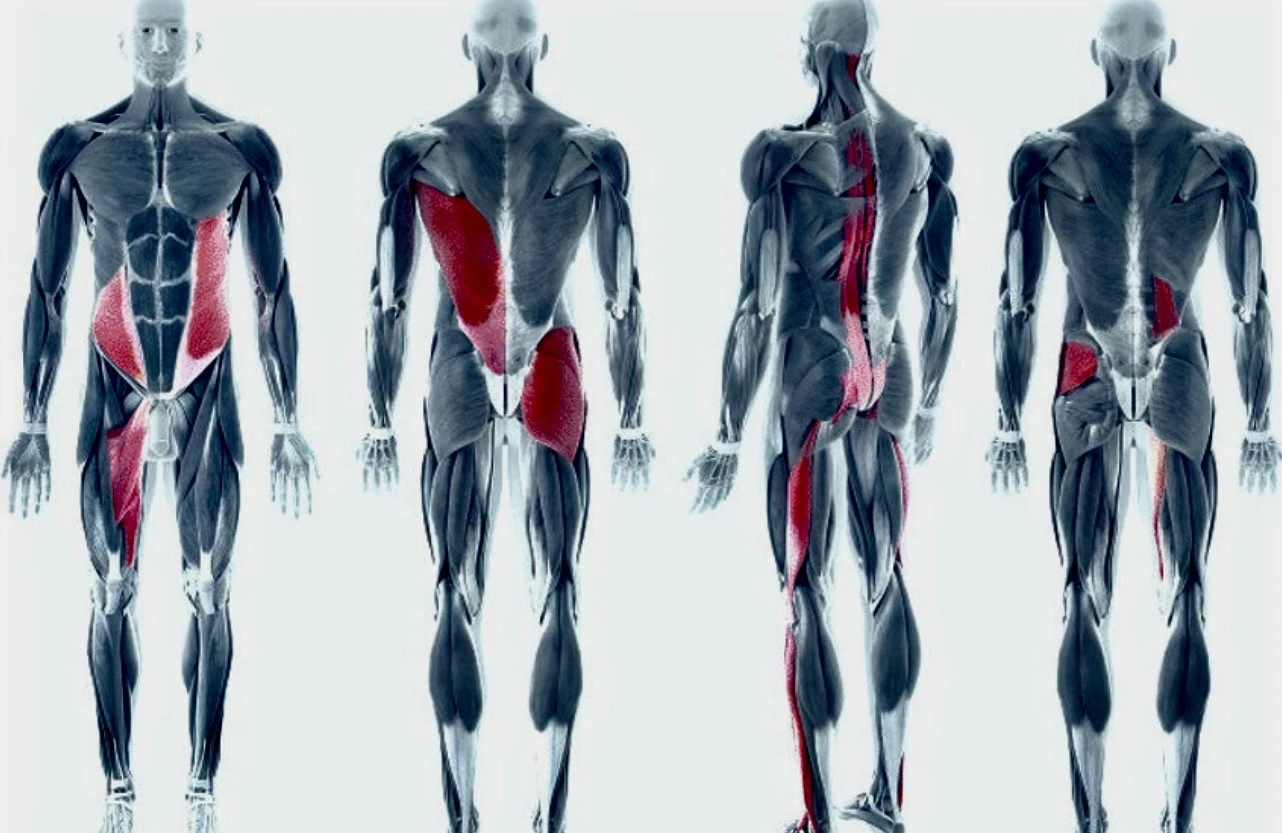
Minute 3 — Introduce the Spiral
Now refine the image.
See the shoulder and opposite hip as two slow gyroscopes.
As the right leg steps forward:
- The left shoulder spirals slightly back
- The ribcage rotates softly
- The thoracolumbar fascia stretches and recoils
Let the movement originate from the ribcage, not the arm.
The arm simply rides the wave.
Breath timing:
- Inhale as the chest rotates open
- Exhale as the body unwinds
You are not walking harder.
You are walking smarter.
Guiding phrase:
“Elasticity replaces effort.”
Minute 4 — Float the Leg
Now add refinement.
As each leg swings forward, imagine it is being gently lifted by the spiral behind you.
The glute engages not by squeezing — but by receiving tension from the opposite shoulder.
Feel the diagonal spring.
You may notice:
- Reduced shoulder tension
- Softer neck
- Easier breathing
- Longer stride without more effort
This is efficiency.
Guiding phrase:
“I move as one connected system.”
Minute 5 — Integrate and Expand
Increase your pace slightly—while keeping the softness.
Notice:
Is your heart rate rising gently?
Is breath steady?
Is effort lower than usual?
This is regenerative aerobic movement.
You are training:
- Neuromuscular timing
- Fascial recoil
- Autonomic balance
- Efficient circulation
Not by forcing.
But by coordinating.
End by slowing your steps.
Place one hand on your shoulder and the other on the opposite hip.
Acknowledge the diagonal line.
Smile.
Even if there are coyotes watching.

This was a really thought-provoking piece that uses the image of coyotes moving naturally in the wild to explain how our bodies are actually designed for efficiency, not strain. I appreciated how it introduced the concept of fascia—the connective tissue network throughout the body—and explained that healthy movement isn’t about forcing muscles to work harder, but about allowing the body’s natural elasticity and coordination to do the work. It really challenges the common belief that effort, tension, and struggle are signs of strength or productivity.
The coyote metaphor was especially powerful. Animals move with fluidity and adaptability because they’re fully integrated with their bodies and environment, while humans often override those natural patterns with tension, poor habits, and stress. It left me thinking about how much of what we call “effort” might actually be unnecessary compensation rather than true strength. Overall, a fascinating perspective that makes you rethink movement — and even how we approach challenges in everyday life.
I appreciate your perspective, Pauline! Keep moving efficiency, with grace and intuitive knowing!
What a fascinating read! I found the idea that “effort” is not always the answer, especially thought-provoking. The comparison with the coyote made me pause and reflect on how often I try to force progress instead of allowing things to flow more naturally.
I am particularly intrigued by the connection to fascia and how our bodies respond when we let go of excessive effort. It feels almost counterintuitive, especially since we’ve been taught that more effort leads to better results.
This got me thinking: how can I practice this in real life? Are there simple exercises or cues you use to recognize when you’re exerting too much effort versus moving in a more efficient, relaxed manner? How long does it usually take to notice a difference?
I really appreciate how this challenges the “push harder” mindset. It has definitely given me something to think about!
Thanks for reading and responding to the article, Alysanna!
I’m happy to hear that you resonated with the concept of effort verses efficient movement. Qigong taught me this. You might research that for yourself.
Fascia responds pretty quickly to change in behavior. The control cells within the fascia, called fibroblasts, are continuously accessing tension and they respond by lengthening or contracting the connective tissue around muscle fibers, tendons and the attachments.
Feel free to message me with questions or insights!
Keep on thriving!
Al
Engaging story and a refreshing perspective on movement. The coyote encounter made the lesson memorable, especially how reactive effort created strain while coordinated, spiral-based movement restored ease. The connection between fascia, breath, and efficiency was explained beautifully. It challenges the usual “push harder” mindset. Do you think most people could relearn this kind of fluid movement through simple daily walking practices?
Thanks again for following this series, Muyivu!
Walking can be a Qigong exercise. Adding simple spiraling movement to the Joimts while walking mindfully is a wonderful moving meditation!
Stay well and thrive, my friend!
Al
I really enjoyed the way you explained the difference between force and coordination in movement. The part about the body reorganizing instead of powering through pain really resonated with me. It’s interesting how often we’re conditioned to believe that pushing harder is always the solution, when sometimes the body just needs better alignment and rhythm. The spiral walk idea was fascinating too — it makes you realize how connected everything is from shoulder to opposite hip when we move naturally. Do you find that most people notice a difference quickly when they try this kind of movement awareness, or does it usually take some time for the body to relearn those patterns?
Thanks, Jason, for reading and responding to the article.
Yes, if folks indeed focus their minds on the balance and intricate workings os the body while doing something as simple as walking, then movement becomes more fluid, the message of the pain is understood, and then released. Then movement becomes medicine!
Keep on thriving!
I was doing this exercise from minute one to minute 5 not physically but in my mind as I was reading this physical exercise. I felt strengthening my spirals I actually felt the emotions between my body. about facial of our faces besides doing the exercises do you have any recommendations of the facial application one can do for facial smoothening. At first when I was reading the content I didn’t understand it was about the exercise, but as I was moving to the end it was of more educative which I may refer my friends to read this page to carry out the exercise in the morning which actually takes 10-15 minutes. Once again thanks a lot for sharing this for free.
Thanks, Divican, fire your response!
I want to be clear, because you may be confusing fascia, and fascial response, with the face and facial skin.
Fascia is connective tissue that surrounds all muscle fibers, tendons, organs and even bones. Stress and trauma of all kinds affect this tissue, causing it to thicken and bundle, which can bring stiffness, discomfort and pain throughout the body. This is what I was referring to.
Keep on thriving!
This is a beautifully written reflection, and I really like how it connects a real-life moment with a deeper understanding of movement and the body. The contrast between Ginger’s reactive energy and the calm, efficient presence of the coyotes is especially powerful, it makes the lesson feel very grounded and relatable.
The explanation of fascia and coordinated movement also stands out. It’s a great reminder that not all progress comes from pushing harder, sometimes it comes from moving more intelligently. The idea that the body responds better to rhythm, breath, and flow rather than force really challenges how many of us approach exercise and recovery.
I also appreciate the practical “spiral walk” section, it turns an abstract concept into something people can actually try. Overall, this is both insightful and useful, blending storytelling with a meaningful takeaway about mindful movement.
Thanks, Andrejs, for you’re thoughtful response! I’m happy you resonated with the article!
I hope the information enhances your well-being!
Keep on thriving!
Al
This was such a beautiful and thought-provoking piece! I love the comparison between the effortless, “liquid” movement of the coyotes and the way our own fascia operates when we aren’t fighting against ourselves. It’s a powerful reminder that our bodies are designed for flow rather than the rigid, mechanical effort we often force upon them in our daily lives.
I have a question regarding this “myth of effort”: For someone who has spent years training their body to work through tension and “pushing,” what is the best way to start unlearning that habit? When we try to move more like the coyote—fluid and responsive is it more about a mental shift in visualization, or are there specific Qigong movements you recommend to help the fascia release its “grip” and return to that natural state of bio-tensegrity?
Thank you so much for sharing such a vivid story and for helping us see the connection between the wild world around us and our own internal health!
That’s a great question, Iyere! We are certainly taught to push through challenges! While this method is admirable in a courageous context, it also falls in the category of rehearsing stress. To rehearse calm while still keeping up our courage, see challenges as messages rather than as opponents to be tackled. Then do some of the things I outline in another blog: https://qiworks.net/turning-ev… – but I think you already commented on that one!
Regardless, keep on thriving!
This really resonated with me. My husband had a heart attack a couple months ago, and even now he still walks out in the bush with our Anatolian Shepherd/Border Collie cross. Living off-grid, you become very aware of how the body reacts to stress, tension, and even fear. I’ve noticed the same thing you described — when we tense up and force movement, everything seems to hurt more, but when we slow down and move more naturally, the body settles. I also really liked what you said about animals understanding energy. Our dog seems to pick up on everything before we do. Have you found these spiral walking techniques help with anxiety and stress too, not just physical tension?
I’m happy this resonated with you, Letsret!.
To answer your question, yes the spiral walking techniques also keep us present as we do them which tells the nervous system that we are safe, and that lowers the stress factor!
Keep thriving!
Hi there,
Have you noticed whether people who carry chronic stress or anxiety struggle more with this kind of spiral-based movement because their bodies are constantly bracing without realizing it?
You mentioned fascia responding to safety and rhythm. Do you think modern gym training sometimes works against natural movement patterns by encouraging isolated tension over coordinated motion?
How long did it take you personally to stop defaulting to “push harder” and start recognizing when the body was asking for reorganization instead of more effort?
Do you think animals naturally preserve healthier fascial movement because they don’t mentally rehearse stress the way humans do?
Have you seen these spiral walking concepts help older people improve balance or reduce joint pain over time, especially in hips and shoulders?
Cheers,
BRoman
Thanks for your comments on the article, Bob!
Yes, I have noticed how folks carry stress without knowing it and blogged about that here: https://qiworks.net/stress-bli…
Spiral walking is excellent for balance, especially as we age!
Keep on thriving, Bob!
Your experience beautifully reflects current understanding of fascial continuity and neuromuscular regulation especially how the thoracolumbar fascia integrates contralateral movement and redistributes load throughout the kinetic chain. What stands out most is your shift from protective bracing to coordinated, breath-led motion, which likely reduced sympathetic guarding and restored efficient movement variability. Research increasingly supports the idea that pain modulation is deeply influenced by perceived safety, rhythm, and elastic recoil rather than force alone. The contrast between Ginger’s reactive intensity and the coyotes’ effortless economy makes this not only a compelling story, but also an excellent illustration of how coherence and flow can restore function more effectively than muscular effort.
I appreciate your input, Kavitha!
Keep on thriving!????