

Throughout human history, there has always been an enemy.
A tribe across the river.
A nation across the border.
A belief system that challenges our own.
Humans have become very skilled at identifying “the other.”
And once the other is identified, the ancient script begins:
They are the problem.
They must be stopped.
They must be defeated.
But there is a quiet truth that has echoed through wisdom traditions for thousands of years.
Destroying the enemy rarely destroys the conflict.
Because the enemy is not only outside of us.
The enemy lives in the human nervous system itself.
The Ancient Program
Our brains evolved in small tribal groups. Survival depended on quickly identifying threats.
Is that person friend or foe?
Is that tribe safe or dangerous?
So the brain became efficient at dividing the world into two categories:
Us
Them
This instinct once protected us.
But in a modern, interconnected world, the same instinct can create cycles of conflict that last generations.
Wars end.
But the psychology that created them often remains.
And when it does, a new enemy eventually appears.
The Teacher We Do Not Want
This is where an uncomfortable idea enters.
What if the enemy is also a teacher?
Not a teacher because their actions are correct.
Not a teacher because conflict is pleasant.
But a teacher, because opposition reveals imbalance.
In Taoist philosophy, yin and yang exist in dynamic tension.
Opposites define each other.
Without resistance, there is no awareness of force.
Without darkness, we cannot recognize light.
Sometimes the enemy reveals our blind spots.
Sometimes the enemy exposes our fear.
Sometimes the enemy reminds us that our own perspective is not the entire universe.
Meeting Hatred with Awareness
Responding to hatred with hatred is easy.
It is instinctive.
It is ancient.
It is predictable.
Responding with awareness is much harder.
But history has shown that the greatest transformations in human consciousness have come from those willing to step outside the cycle.
People who refused to dehumanize their opponents.
People who insisted on seeing humanity even where conflict existed.
This approach does not mean surrendering to injustice.
It means refusing to let hatred define the future.
The Nervous System of War
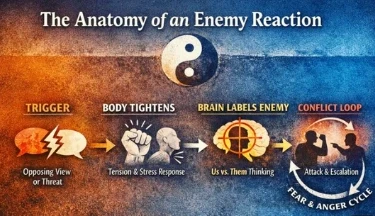
Conflict does not only happen between nations.
It happens inside the body.
When the nervous system is flooded with fear, anger, and stress, it becomes difficult to see clearly.
The body tightens.
Breathing becomes shallow.
Perception narrows.
In this state, the brain searches for threats.
And threats are easily turned into enemies.
This is why practices like Qigong, breathwork, and meditation are not just wellness tools.
They are consciousness tools.
A regulated nervous system can tolerate differences.
A dysregulated nervous system demands an enemy.
The Real Work
Peace in the world does not begin with governments.
It begins with individuals learning to regulate their internal landscape.
When a person learns to breathe through anger rather than act on it…
When someone learns to see another perspective instead of immediately defending their own…
When awareness enters a moment of tension…
A different possibility appears.
And slowly, quietly, the pattern begins to shift.
The Long Evolution
Humanity may never eliminate conflict entirely.
Even nature contains tension.
But we can evolve how we respond to conflict.
From reaction
to awareness.
From hatred
to curiosity.
From enemies
to teachers.
It is not the easiest path.
But it may be the only one that leads us forward.
And every time a human chooses understanding where anger would have been easier…
The future changes, just a little.
Interesting concept. You are right though, there has been conflict throughout times, and sometimes some great lessons to be learned at the end of it.
It could also be compared to the conflict within ourselves which happens whether we like it or not. The trick is to find what we can learn about ourselves as we try to resolve it.
The same with arguments with others. There is always a way to learn from each other, and no one person has all the right answers.
Thanks, Michel!
Yes, there are always lessons to learn from conflict, no matter the scale. If we humans can get out of our need to be right, and see the deeper teaching, we could certainly improve everyone’s lives!
it is true all long that the enemy we are fighting lives in our nervous system to add more the enemy is in our blood system. it is all true that the war starts from our brains and it is true from you that we stopped physical war and the really war is in our minds. is better for us to train ourselves to love each other from our nervous system and eventually we will conquer this enemy. Thank for teaching me all this.
Your welcome! Thanks for resonating with the article!
Stay well!
This is an interesting perspective, and there are parts of it that line up with truth—but from a Christian standpoint, it needs a clearer foundation.
Scripture does acknowledge that there’s something happening inside us that fuels conflict. Not just biology or the nervous system, but the sin nature of the human heart. Jesus said, “out of the heart come evil thoughts, murder, adultery…” (Matthew 15:19). So the problem isn’t just external enemies—it’s also what’s within us.
At the same time, the Bible is clear that the “enemy” isn’t limited to ourselves either. There is real evil in the world, and even a spiritual battle behind it. “We wrestle not against flesh and blood…” (Ephesians 6:12). So reducing everything to internal regulation misses part of the picture.
Where I do agree is this: reacting in anger, hatred, and fear only fuels more conflict. Scripture calls us to something different, self-control, wisdom, and even loving our enemies (Luke 6:27). That doesn’t mean ignoring injustice, but it does mean responding in a way that reflects Christ, not just our instincts.
The biggest difference is this:
The solution isn’t just awareness or calming the nervous system.
The solution is transformation through Christ.
Real peace doesn’t come from managing reactions alone—it comes from a changed heart, guided by the Holy Spirit. That’s what allows someone to respond with truth, conviction, and grace at the same time.
So while the article touches on something real, it stops short of the full truth. The issue isn’t just how we’re wired—it’s who we are apart from God, and who we can become through Him.
Your truth, your belief system.
Billions of people are not Christians. The biggest problem I have with this teaching, is the audacity to think that it’s the only way.
That’s ego, not divine.
The source I speak to, pray to, and follow doesn’t speak in the way a human reasons.
I’m happy you have a practice.
But to me the bible is hearsay. Manipulated to control the masses.
I trust only what I experience, not what anyone tells me.