

When Life Becomes Qigong.
Modern life has a curious rhythm.
Everyone seems busy.
Calendars overflow.
Phones buzz.
To-do lists grow longer than a winter night.
As a Qigong teacher, I hear the same sentence almost every week:
“I love Qigong… I just don’t have time to practice.”
And I understand.
Life is full. Work calls. Family needs attention. The laundry somehow multiplies when we’re not looking. The dog still wants to be walked, the dishes still appear in the sink, and gravity continues pulling the trash can toward the curb every Thursday morning.
But here’s the quiet secret of Qigong.
It was never meant to be only an exercise routine.
It was meant to be a way of moving through life.
The Hidden Practice We’re All Doing
The truth is, we are already practicing something all day long.
Most people are simply practicing Stress Qigong.
They rehearse it beautifully.
Shoulders lifted.
The jaw is tight.
The breath is shallow.
Mind racing ahead to the next task.
Over time, the body becomes fluent in this pattern.
The nervous system adapts.
The fascia tightens.
The breath becomes short and guarded.
Eventually, tension begins to feel normal.
But the body becomes what it practices.
If we rehearse stress all day, the nervous system becomes fluent in stress.
If we rehearse breathing, it becomes fluent in calm.
The Real Secret of Qigong
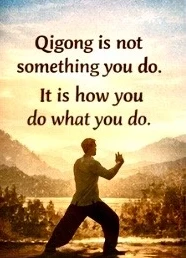
Here’s the part many people miss.
Qigong does not require a special room, a mat, incense, or even twenty uninterrupted minutes.
Qigong requires awareness.
When awareness enters movement, something subtle begins to happen.
The breath deepens.
The body softens.
Energy begins to circulate through tissues that were previously braced against the world.
As I often tell my students:
When awareness enters movement, Qi begins to flow.
When Qi flows, even the smallest moment becomes medicine.
Turning Daily Life into Practice

Once you understand this, something wonderful happens.
Ordinary activities transform.
The laundry becomes a breathing meditation.
Walking the dog becomes a moving energy practice.
Even washing dishes can become a moment of grounding.
Not because the task changed.
But because you did.
Folding Laundry Qigong
Next time you fold clothes, slow down just slightly.
Inhale as you open the shirt.
Exhale as you fold it.
Feel the gentle spiral of the arms. Imagine they’re floating
Relax the shoulders. Let the breath guide the rhythm.
Suddenly, what was once a chore becomes a small moment of calm.
Walking Qigong
Walking is one of the most natural Qigong practices we have.
Try this simple rhythm:
Inhale for three steps.
Exhale for three steps.
Let the arms swing naturally.
Feel the feet connect with the earth. Lengthen your strides, but walk slower.
Instead of rushing from point A to point B, you become aware of how the body moves through space.
The fascia network begins to glide.
The breath steadies.
The mind quiets.
Dishwashing Qigong
Warm water flows across the hands.
Slow circular movements. As your hand spirals, washing the plate, imagine the planets spiraling around the sun!
Jaw relaxed.
Spine gently lengthening upward.
This simple sensory awareness shifts the nervous system into a calmer state.
The body interprets this message as a signal of safety.
And when the body feels safe, healing begins.
The Five-Second Reset
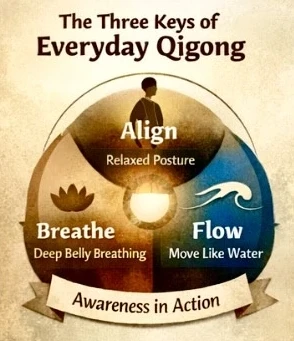
Here is the simplest Qigong practice I teach.
It takes ten seconds.
Whenever you remember during the day:
Relax your shoulders.
Take one slow breath into the belly.
Allow the body to soften. Slowly release the breath as you exhale.
That’s it.
Ten seconds.
But practiced ten or twenty times throughout the day, this tiny reset may do more for your nervous system than one rushed practice squeezed between meetings.
A Taoist Paradox
There is a beautiful Taoist principle hidden in all of this.
The less time people think they have, the more powerful this teaching becomes.
Because Qigong does not compete with life.
It moves inside it.
Every task becomes an opportunity.
Every step becomes a practice.
Every breath becomes medicine.
The Lifestyle of Qigong
Eventually, something subtle begins to shift.
You are no longer “doing Qigong.”
You are living it.
The breath flows more easily.
Movement becomes smoother.
The body wastes less energy resisting itself.
And in the middle of a busy day, you may suddenly notice something surprising.
A moment of stillness.
A moment of ease.
A moment of quiet gratitude for simply being alive inside this miraculous body.
And in that moment, you realize something the Taoists understood thousands of years ago.
The practice was never separate from life.
It was life all along.
 imagine
This was a beautiful perspective on practice, and I really appreciate how you reframed Qigong as something that lives inside ordinary moments rather than something that requires carving out extra time. The idea that most people are already practicing “Stress Qigong” all day is such a striking way to describe how habitual tension patterns develop. It made me reflect on how easily the body learns whatever rhythm we repeat—whether that’s shallow breathing and tight shoulders, or calm breathing and relaxed movement. I’m curious whether you find that students initially struggle with the idea that such small shifts—like a single conscious breath or relaxing the shoulders—can meaningfully change their nervous system over time.
I also loved the examples of folding laundry, walking, and washing dishes as opportunities for awareness. Those everyday moments are often where people feel the most rushed, yet they’re also the moments we repeat the most in life. Your description makes it feel much more accessible than the typical idea of “practice time.” Do you find that once people start integrating these micro-practices into daily tasks, they naturally become more interested in deeper or longer Qigong sessions as well? It seems like this approach could be a powerful gateway for people who feel intimidated by formal practices but still want to cultivate calm and presence.
Thanks, Iris, for your thoughtful response!
Generally people are surprised how transformative those mindful moments can be. The challenge is to make them the habitual actions rather than the rushed tasks performed while thinking of the next thing on the list, and not being present at all.
But yes, once adopted, most folks want more!
Keep on thriving!
I really enjoyed how this article reframes Qigong not as a separate task to squeeze into an already full schedule, but as something woven into the fabric of everyday life. The idea of turning ordinary activities like folding laundry, walking, or washing dishes into moments of awareness and calm makes the practice feel much more accessible and relevant to modern living. It was interesting to read about how stress patterns can become habitual and how simple awareness can begin to shift that. In your experience, what are some common challenges people face when they first try to bring mindful awareness into these everyday tasks, and how do you suggest overcoming them to make these micro‑practices truly habitual?
Thanks, Hanna, for your thoughtful response!
I’m happy you resonated with the article.
The biggest challenge people face when bringing this mindful awareness into everyday tasks is to be fully present. Our modern realm has so many distractions, it’s become difficult to be fully present in the activity in front of us. Our minds are full of our “to-do” lists, and “what if’s.” This is the perfect process to get out of that mode, if one truly commits to the practice!
Keep on thriving, Hanna!