

When a child first learns to ride a bike, it’s a wobbly adventure.
Their legs pedal. Their arms grip too tightly. Their whole body looks like it’s negotiating with gravity in real time. But something incredible is happening inside their brain. Each attempt lays down tiny neural pathways — connections between brain cells that say, “This is how we balance. This is how we move forward.”
With practice, those pathways get smoother and stronger. Eventually, the child no longer thinks about riding the bike. Their body just knows.
This is the magic of repetition. And it’s the same magic at work in Qigong.
Your Brain Is Always Taking Notes
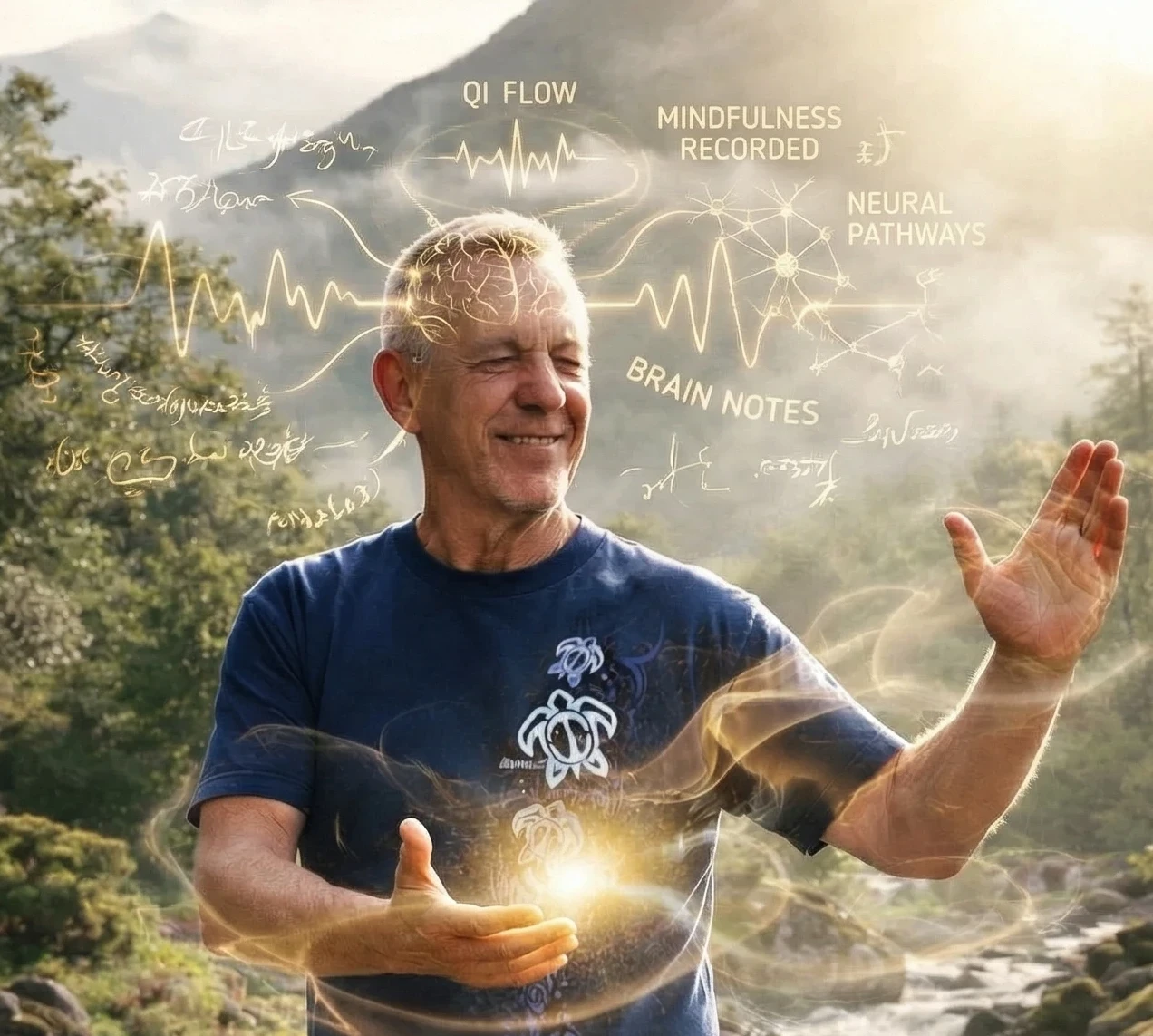 Every time you repeat a Qigong movement, your brain builds a more efficient “map” of that motion. Neurons that activate together begin to form stronger connections. Scientists call this neuroplasticity. I call it your inner wiring crew upgrading the system.
Over time, the movement becomes easier, more fluid, more natural. Your body learns the dance.
But here’s where Qigong becomes something more than gentle exercise
You’re Not Just Moving — You’re Imagining
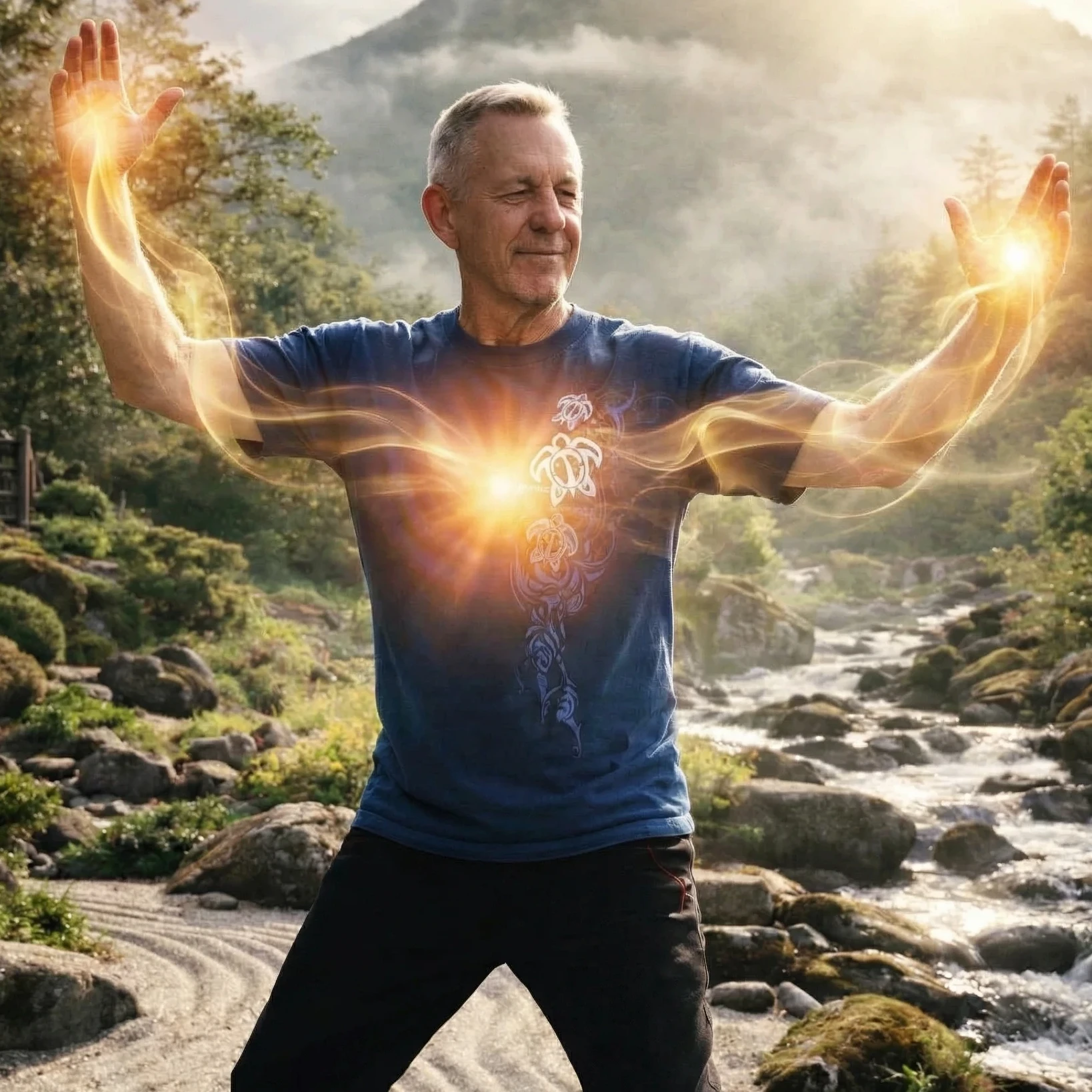 In Qigong, we don’t just lift an arm.
We might imagine warm light flowing through the chest.
We might feel roots growing into the earth.
We might sense tension melting away like ice in sunlight.
When you add visualization, your brain doesn’t shrug and say, “Oh, that’s just pretend.”
It responds as if the experience is real.
The brain regions that process sensation, emotion, and body regulation begin to activate alongside the motor centers. Your nervous system listens. Your breath shifts. Your muscles soften. Your stress response quiets down.
Now the brain isn’t just learning a movement.
It’s learning a state of being.
The “Piggyback Effect”
Think back to the child on the bike. Now imagine that every time they practiced riding, they also listened to their favorite song and felt safe, happy, and free. Over time, riding the bike wouldn’t just mean balance and motion. It would also mean joy and confidence.
The movement and the feeling would become linked.
That’s what happens in Qigong.
When you repeat a movement while visualizing healing light, calm water, or flowing energy, your brain starts to connect:
This movement…
with this inner image…
with this emotional tone…
with this relaxed, balanced body state! They all travel together!
In a very real way, the visualization “rides along” with the movement in your nervous system. Each time you practice, you’re braiding motion, imagery, and physiology into one integrated pattern.
Eventually, the Body Remembers the Feeling
After enough practice, something beautiful happens.
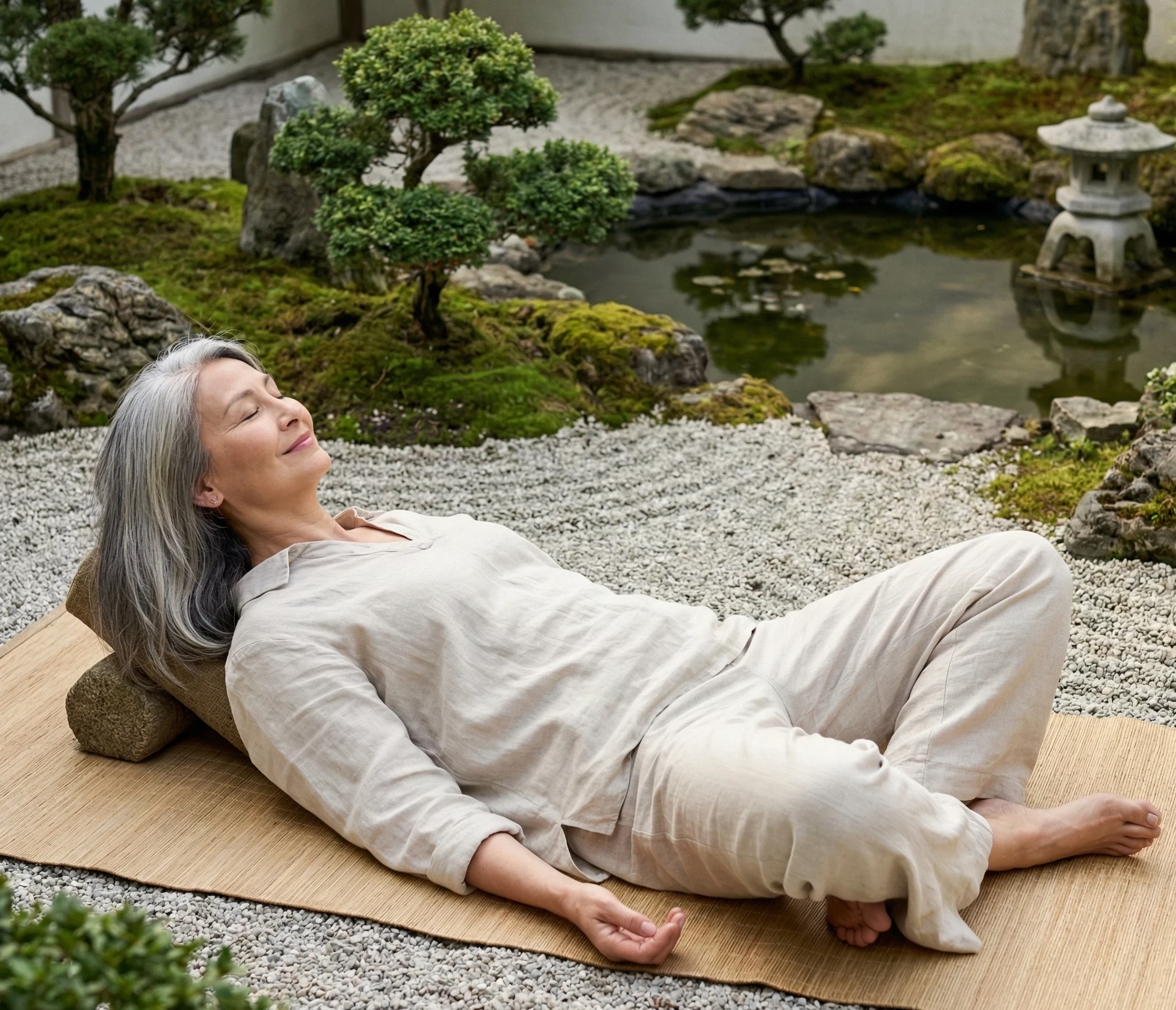 You step into a familiar Qigong posture… and your body begins to relax before you even try. Your breath deepens on its own. A sense of calm or openness arises almost automatically.
You didn’t force it.
You didn’t think your way there.
Your system recognized the pattern.
The movement became a doorway into a healing state.
This Is Why Visualization Matters
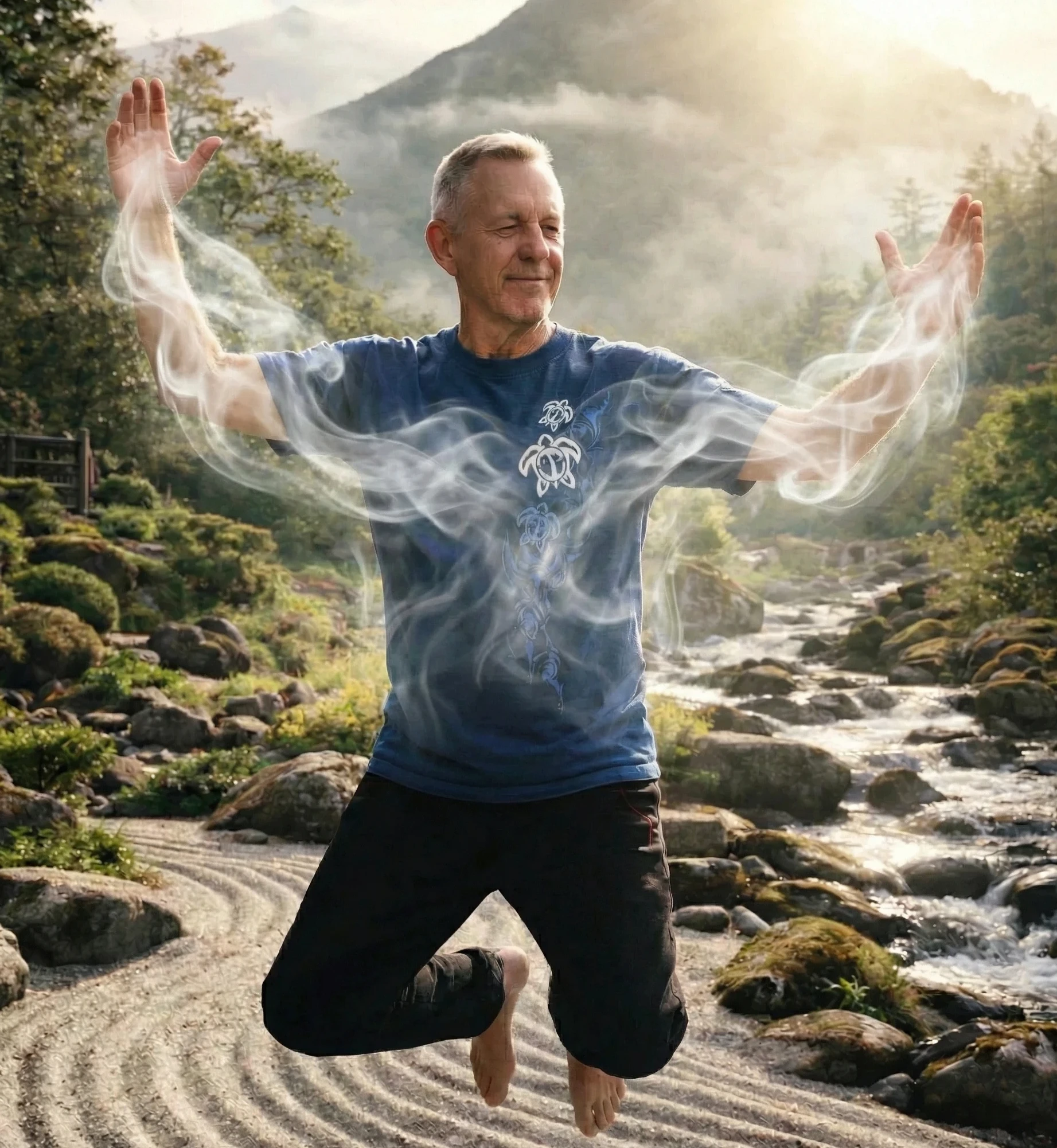 Visualization in Qigong isn’t about pretending. It’s about teaching your nervous system a new baseline.
Instead of rehearsing stress, tightness, and survival, you begin rehearsing:
Flow
Safety
Strength
Balance
Over time, your body learns these states just as surely as it learned to ride a bike.
And once learned, they’re easier to return to — not only during practice, but in the middle of daily life, when you need them most.
That’s the quiet power of combining movement with imagination.
You’re not just exercising your body.
You’re training your whole being to remember what harmony feels like.

A 3-Minute Qigong Visualization to Feel This for Yourself
You don’t need special skills. Just curiosity.
1. Find Your Posture.
Stand or sit comfortably. Let your spine be tall but not stiff.
Soften your shoulders. Let your hands rest loosely by your sides or on your lap.
Take a slow breath in through your nose…
and a long, easy breath out through your mouth.
Again. Inhale gently…
Exhale slowly.
2. Add a Simple Movement.
On your next inhale, slowly lift your hands in front of you to about chest height, palms facing your body, as if you’re holding a soft, invisible ball.
On your exhale, let your hands float back down.
Move slowly. No strain. Like you’re moving through warm water.
Repeat this gentle lifting and lowering two more times with your breath.
3. Now Add the Visualization.
As your hands rise on the inhale, imagine a soft, warm light gathering between your palms — like sunlight filtered through morning mist.
As your hands lower on the exhale, imagine that light flowing into your chest and spreading through your body, washing away tension and fatigue.
Nothing dramatic. Just a quiet sense of warmth and ease.
Inhale — light gathers.
Exhale — light flows through you.
Repeat for three slow breaths.
4. Let the Body Notice.
Now let your hands rest.
Notice your breath.
Notice your shoulders.
Notice your face.
Do you feel even a small shift — a little more space, a little more calm, a little more presence?
That change didn’t come from force.
It came from combining movement, breath, and imagination.
Your nervous system just practiced a new pattern.

This Is How Qigong Rewires Wellbeing
Each time you pair gentle movement with a healing image and relaxed breathing, you teach your brain and body:
“This is what balance feels like.”
“This is what safe and open feels like.”
“This is a state I can return to.”
With repetition, the body remembers.
And what the body remembers… it can live from.
Check out my IChing Qigong Daily Qigong practice. A short, simple way to embrace each day, and it is free.

Thank you for such a vivid and engaging explanation. From a communication perspective, you do an excellent job of making complex ideas like neuroplasticity accessible through story, metaphor, and step-by-step guidance. Readers can see and feel what you mean.
I also admire how your pacing mirrors the practice itself. The gentle rhythm, repetition, and clear cues naturally guide attention and create the calm state you’re describing. That’s skillful, intentional communication.
I appreciate your kind comments, Kavitha! Keep on thriving!!
I agree that visualization is important in daily life. Visualization takes practice for it to become effective. We could all benefit from learning visualization. The article states, it could make the movements we make every day more fluid. This would also make our movements more efficient. Visualization could help alleviate stress which we could use less of in our lives. Thank you for sharing another way to enrich our daily lives.
Thank You, Missy! Yes, visualization is a great tool for manifestation in a practice, or in daily life! Keep on thriving!
This article really opened up a deeper way of thinking about Qigong for me, especially the idea that the body is not just learning movements but learning states. The comparison to riding a bike made the neuroscience behind repetition and visualization very easy to understand, and I liked how you explained visualization as something the nervous system responds to as real, not imaginary. It made me reflect on how often we rehearse stress unconsciously instead of calm.
Do you think this “piggyback effect” also explains why some people feel emotional shifts during practice, not just physical relaxation? And for beginners who struggle with visualization, is simply focusing on breath enough at first, or does imagery play a critical role early on?
Thanks for your comments, Angel!
Yes, we humans often rehearse stress!
Visualizations work for the manifestation of well-being in Qigong and in daily life! When our everyday process of life in general becomes the practice, then we can really create change in ourselves and our community. Beginners have to start somewhere. I start my students with imagining that the breath fills them with some color, depending on the element we’re working on, before teaching any formal Qigong exercise at all. Imagination directs the mind, then the mind and the breath direct the flow of Qi.
I’m fairly new to Qigong and have been curious about how visualization fits into the practice; your explanation made the idea feel approachable rather than mysterious. It really resonated how you describe visualization not as fantasy, but as a way of helping the brain and nervous system learn a state of being alongside the physical movement. It’s almost like training the body and mind together rather than separately.
I’ve seen discussions noting that visualization isn’t used the same way in every Qigong lineage. Some teachers emphasize feeling the Qi more than picturing it. That makes me even more curious about your experience with it over time! Thanks for sharing. This gives me a great starting point to explore visualization in my own Qigong sessions.
Thanks for reading and commenting, Leica!
Yes, there are many interpretations based on linage and generational changes.
What I’ve found of that it’s easier to feel the Qi moving when you add visualizations. Then you not only have the breath and movement, but also the mind directing the Qi through those visuals. Also, giving the mind a task to do while in practice, keeps it present, and not wondering into future tasks to do, or past occurrences, which is not helpful.
Let me know, is you like, what you’re experience is!
Keep on thriving!
Al
I have heard and read about Qigong, but I have never been able to get started usinng it. I have been using visualization and medication for years, so this is something I am interested in maybe adding to my relaxation routine.
Wow, I am impressed it only takes 3-minutes to use Qigong and visualizatioin for the benefits. I thought it would be much longer time periods than that, I can easily add this to my relaxation routine.
Your simple step-by-step guide is extremely useful for me to begin using Qigong and visualization, I thank you for an easy to understand article to help me get started.
Jeff
Thanks, Jeff, for reading add responding to the article!
I hope your experience with Qigong is helpful!
Here’s a link to my YouTube channel for some short videos to help.
https://youtube.com/@alperryqi…
I find the connection you draw between repetition, neuroplasticity, and visualization especially interesting, because it reframes Qigong as more than just slow movement. The idea that pairing imagery with breath and posture can condition a calmer baseline makes sense, particularly in a world where many of us rehearse stress without realizing it. It opens up a thoughtful discussion about how intentional inner imagery, when practiced consistently, might shape not only physical relaxation but also our broader response to daily pressure.
Thanks, Aly, for reading and responding to the article.
Yes, reframing what we rehearse, stress or calm make a huge difference!
When we learn how to move with the fascial web instead of against it, something surprising happens…
Strength improves. Pain decreases. Breathing deepens. Energy rises.
Visualizations, breath and conscious, present movement reinforce this calm, efficient state of well-being!
Keep on thriving!
Al
This was a thoughtful explanation of how visualization deepens the effects of Qigong practice. The way you connected neuroplasticity, movement, and emotional states made the concept easy to grasp. I also liked the “piggyback effect” idea; it clearly shows how imagery and motion become linked in the nervous system. Do you think beginners benefit more from simple visualizations before moving to complex ones?
Thanks again for reading this series, Muyiva!
Yes, it’s important to begin with simple movements, abd connect them with appropriate visualizations and breathing. Movement, breath and visualizations are a potent triad for the manifestation of wellness!
You have a very interesting and informational article, Albert. Correct me if I am wrong, but Qigong appears to be an active movement-based and a passive meditation-based exercise or routine. It appears to be excellent for many areas of one’s health, including stress reduction, pain management, and improved cardiovascular health. One question I have is this: Is Qigong associated in any way with Tai Chi? Thank you for a very educational article.
Best wishes,
Kent
Thanks, Kent, for reading and responding to the article.
Tai Chi, or Taijiquan, is a hybrid of Qigong and Martial Arts. Qigong is one of the five branches of Chinese, or Taoist medicine. Taiji was developed to train fighters.
And yes, Qigong is like a moving meditation, and even more, a medicine.
Keep on thriving!
Al
This is the first time that I have heard of Qigong. I tried out your example exercises and they felt great. Is Qigong something you can teach yourself or is it something you need to go to a coach to learn?
The movements seem very similar to what you would do when you meditate or even do yoga relaxation techniques, so I think the difference here would come in with the movement of your body parts while visualizing.
Hi Michel!
Thanks again for your thoughtful response.
I’ll give you a link to my YouTube channel. I have many Qigong exercises there and easy for a beginner to follow.
Keep me posted, and let me know if you have any questions.
Continue to thrive!
https://youtube.com/@alperryqi…