

 On a stormy day, I find myself fascinated with the trees as they bend with the wind.
They don’t snap — unless they are rigid.
The same is true of us.
From Bio-Tensegrity to Facintegrity
For years, many movement scientists and manual therapists have embraced the biotensegrity model, a term championed by orthopedic surgeon Stephen Levin and inspired by architect Buckminster Fuller.
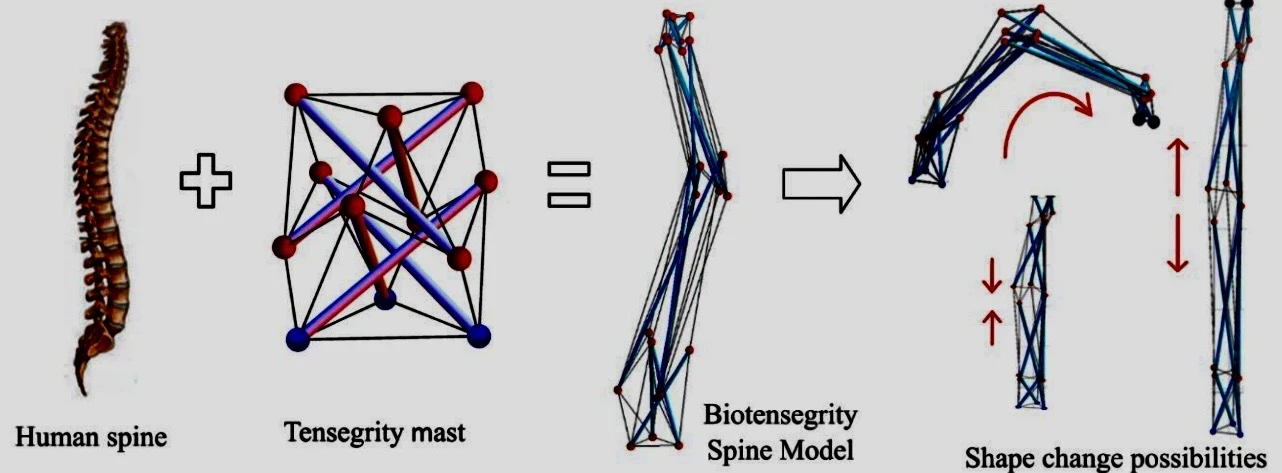
The idea is elegant:
Bones are not stacked like bricks.
They float inside a web of tension-bearing tissues.
Fascia, muscles, and tendons create continuous tension.
Bones act like compression struts.
Instead of levers and pulleys, the body becomes a suspension bridge.
This model changed everything.
It helped us understand why tension in one shoulder can influence the opposite hip.
Why twisting the foot can echo up into the jaw.
Why spiraling Qigong feels so… integrative.
And yet — as beautiful as this model is — something was missing.
Water.
The Part We Forgot: We Are Mostly Fluid
Your fascia is not dry rope.
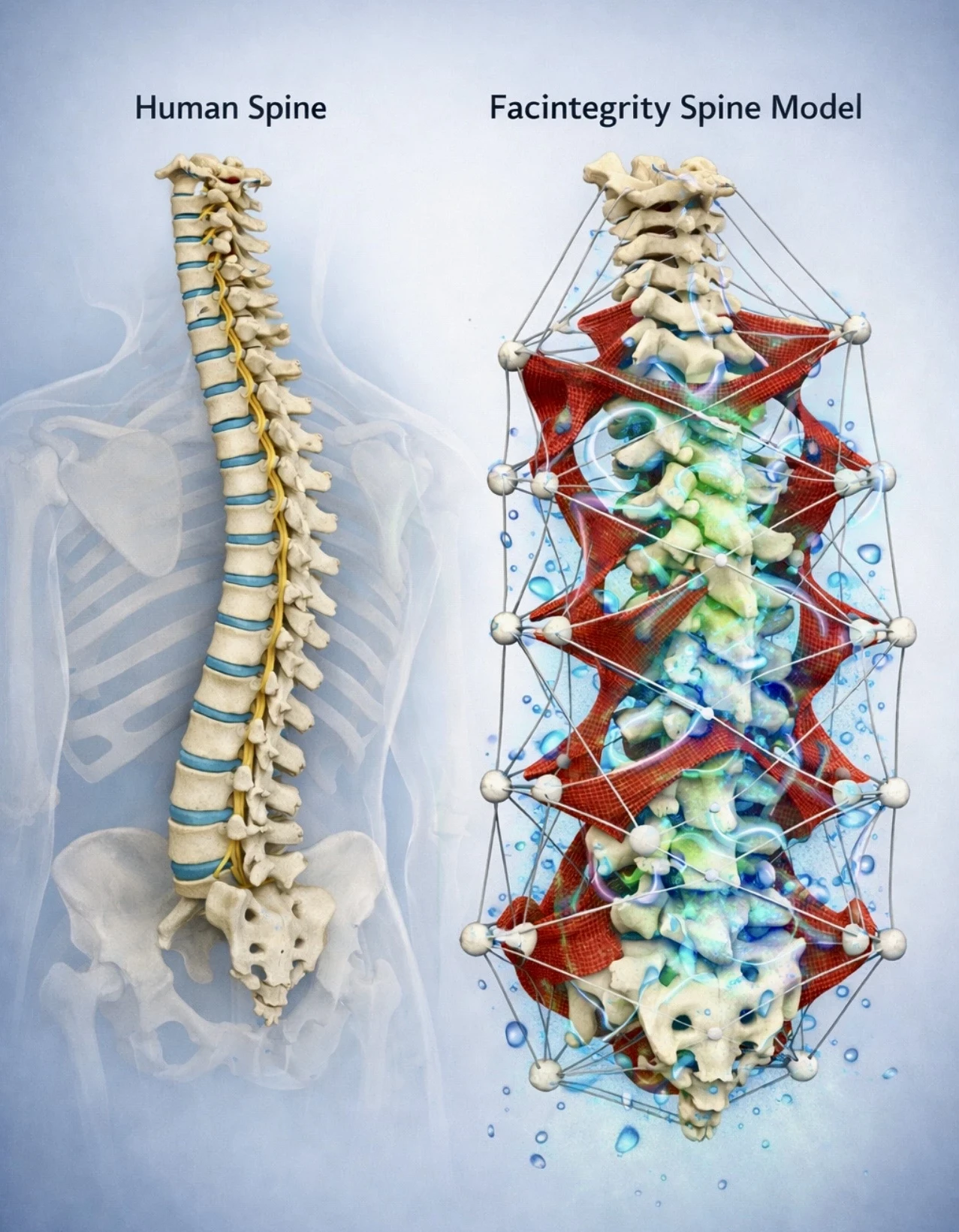
It is a hydrated, gel-like matrix.
It is collagen suspended in ground substance.
It is saturated with interstitial fluid.
It is alive.
Researchers have begun using the term facintegrity to describe a more complete view — one that accounts not only for tension and compression, but also for fluid dynamics.
Because here’s what’s fascinating:
Your fibroblasts — the cells that build collagen — are not only sensitive to stretch. They are sensitive to:
- fluid pressure.
- To shear forces.
- To hydration levels.
- To inflammation.
- To subtle changes in the internal environment.
If tension is the architecture, let’s view fluid as the climate.
And climate determines behavior.
Why This Matters for Your Body
When you are under stress, your nervous system tightens.
When you are inflamed, your tissues thicken.
When you stop moving, fluid stagnates.
And when fluid stagnates, fibroblasts can begin laying down protective collagen — reinforcing the “armor.”
This is not your body betraying you; it’s your body protecting you.
But this protection, when chronic, can become a painful prison.
In my book, Fractured To Freedom, I talk about how fascia contraction often begins as wisdom.
Fascia thickens to guard against injury.
Muscles brace to stabilize emotion.
Collagen densifies to contain trauma.
But if the storm never passes, the tension becomes the new identity, the new normal!
That is where Qigong enters.
Qigong: The Art of Fluid Remodeling
When you spiral slowly in Qigong…
You are not stretching your muscles.
You are shifting pressure gradients.
When you breathe deeply…
You are not “relaxing.”
You are altering thoracic pressure, influencing venous return, and enhancing lymphatic flow.
When you visualize light washing through tissue…
You are shifting autonomic tone, which changes chemistry, fluid behavior, and fibroblast signaling.
You are hydrating the matrix.
You are restoring glide.
You are whispering to the climate inside your body.
That is facintegrity in motion.
Storms Outside, Storms Inside
Have you ever noticed how some people ache when the weather shifts?
Barometric pressure changes.
Interstitial pressure shifts.
Fluid dynamics adjust.
Rigid systems resist.
Hydrated systems adapt.
The same applies emotionally.
When life’s barometric pressure drops — loss, conflict, uncertainty — a rigid psyche fractures.
A fluid psyche reorganizes.
This is not just a metaphor. It is physiology.
The Evolution of the Model
Biotensegrity is not wrong.
It is incomplete.
It gave us structure.
Facintegrity gives us aliveness.
One describes how we hold shape.
The other describes how we respond to change.
And if there is one truth I have learned through decades of Qigong, fascia work, and life itself, it is this:
Resilience is not rigidity.
Resilience is adaptability.
Adaptability requires hydration — physically, emotionally, spiritually.
The Freedom Hidden in Fluidity
When we begin our healing journey, we often try to “fix” tension.
We stretch harder.
We strengthen more.
We brace against the brace.
But true freedom comes when we restore movement to the matrix.
When fluid glides again.
When spirals replace straight lines.
When breath irrigates contraction.
This is why spiraling movements feel different than linear stretching.
Spirals move fluid.
Spirals distribute pressure.
Spirals speak the native language of fascia.
Nature does not move in straight lines… Nor should we!
A Simple Practice to Explore Facintegrity
Stand in Wuji. (Basic horse stance)
Knees soft.
Jaw unclenched.
Breathe slowly.
Place your awareness not on muscle tension — but on hydration. I don’t mean that you should go drink a glass of water… maybe later. Hydrate with imagery!
Imagine your body as a warm, living ocean.
As you inhale, feel subtle expansion — like the tide rising.
As you exhale, feel gentle settling — like the tide receding.
Now add a slow spiral through the spine.
Not big. Not forced.
Just enough to stir the internal waters.
Notice:
It is not the stretch that changes you.
It is the circulation and peace of mind.
Stay here for three minutes.
Your fibroblasts are listening.
From Fracture to Flow
When I look back at my own journey — the fractures, the rigidity, the internal bracing — I see now that healing was never about becoming stronger.
It was about becoming more fluid.
Physically.
Emotionally.
Energetically.
Bio-tensegrity helped me understand my structure.
Facintegrity helped me understand my softness.
And freedom?
Freedom lives where structure and fluid dance together.
Not rigid.
Not collapsing.
Responsive.
So on stormy days — outside or inside — remember:
You are not scaffolding.
You are a living, breathing, fluid matrix.
And the more gently you spiral…
The more gracefully you reorganize.

There is quite a lot of hype all around us at the moment regarding Fascia, and it is something most of us don’t think about much, but it is there almost like an invisible sheath that holds us together.
I see so many programs around today that promote the release of fascia and even for the face to help you look younger. I would love to know how long we have known about fascia and when it all started coming more into the spotlight.
Thanks for reading and responding to the article, Michel!
It’s amusing to me that fascia is finally getting some attention. I’ve been doing myofascial release for over 35 years! Western medicine mostly taught that the fascia was just connective tissue. Studies weren’t abundant, because fascia disorders are not life threatening, and drugs don’t help. Drug companies fund most medical studies. Northern Europe has been my best source of information over the years, as well as my own experience with my clients. Fascia is dynamic and is the primary system for how we move through space. I’ve written quite a few blogs over the past for years, as well as a book. My weby is https://Qiworks.net. go to the blogs section. Also here’s a good primer from the German Institute for Facia: https://fasciaguide.com/fascia…
As far as looking younger… While fascia is made up of mostly collagen fibers, the collagen that gives you’re skin that youthful appearance is a different system.
Let me know if you have any questions.
Keep on thriving!
Al
Excellent article on fascia. It makes perfect sense. I hadn’t thought of it in that way but it makes perfect sense and that explains so much about issues that so many people have.
This post offers a thoughtful and refreshing perspective on fascia by moving beyond the idea of it being just structural “tissue” and instead presenting it as a dynamic, fluid, responsive system. The explanation of how fascia behaves more like a living ocean than a rigid framework makes the science feel accessible, and the connection to movement practices like Qigong helps readers understand why whole‑body tension patterns matter.
The shift from traditional biomechanical models to concepts like biotensegrity and facintegrity is especially helpful for anyone interested in bodywork, movement, or holistic health, because it shows how interconnected and fluid our bodies really are.
It’s the kind of article that makes you rethink how you move, breathe, and even interpret discomfort or tension.
Thanks so much, Criz!
I’m happy to hear that the information was useful for you!
Keto on thriving!
Al
The connection you drew between emotional rigidity and physical fluid stagnation hit differently than I expected. I’ve always thought of stress as something that tightens muscles, but thinking of it as something that literally changes the climate inside the tissue makes the Qigong practice you described feel much more intentional. It’s not just relaxation, but actual internal remodeling.
You mentioned that fascia thickens as a form of protection. But at what point does the body recognize it’s safe enough to let that armor soften? Is that shift primarily nervous system-driven, or does consistent movement practice like Qigong essentially ‘convince’ the tissue directly through fluid and pressure changes?
Thanks for your response, Alice!
The shift that you are referring to, when the body can soften and release, is consciousness driven. When you tell your body to let go, it will. You just need to know the language your body speaks. We, as a species, rehearse stress continuously. All that rehearsal tells the body to stay ready for trauma, because it’s right around the corner!
Rehearsing peace of mind, and trust that everything is exactly how it’s supposed to be, is how one maintains a state of well-being!
Keep on thriving!
Al
Hi there –
Fascinating take on fascia and the role it plays in our flexibility a daily basis. Even though fibroblasts lay down protective collagen, it can be harmful to body. There are numerous reasons why a sedentary lifestyle is generally discouraged. Besides exercising and drinking water, what are other ways to ensure fascia does not become rigid?
Thanks for reading and responding to the article, Godwin!
Keeping stress to a minimum is also very helpful! Fascia accesses stress the same as a physical trauma.
Keep on thriving!
This piece really stayed with me—especially the way you reframed fascia from something structural into something responsive, almost conversational. The shift from “architecture” to “climate” is powerful because it immediately changes how I relate to tension. Instead of something to correct, it becomes something to understand.
What I find particularly compelling is your emphasis that tension often begins as intelligence—as protection, not dysfunction. That feels like a critical distinction that’s often missing in both fitness and healing spaces. It makes me wonder how differently people would approach their bodies if they saw tightness as communication rather than a problem to override. Do you think this perspective alone can begin to change outcomes, even before introducing practices like Qigong?
The idea of “fluid as climate” also opens up a deeper question for me: if fascia responds to internal conditions like hydration, inflammation, and emotional state, how much of what we experience physically is actually downstream of unresolved emotional or environmental stress? And in your experience, is it more effective to address the mechanical side (movement, breath) or the emotional/mental climate first—or do they have to be approached simultaneously?
I also appreciated how you described spirals as the “native language” of fascia. That line alone reframed movement for me. It makes linear training feel almost incomplete by comparison. Have you found that people need to unlearn their existing movement patterns to access this, or does the body naturally remember once given the right cues?
And the Wuji practice you shared—simple, but layered. The focus on awareness of hydration rather than effort feels like a subtle but profound shift. I’m curious, for someone new to this, what would you say is the first noticeable change they might experience if they practiced this consistently?
Overall, this doesn’t read like just a theory—it feels like a lived system. It invites a different kind of relationship with the body: less control, more dialogue. Really thoughtful work.
Iris, thank you! I’m thrilled that you resonated with the article!
Yes, viewing your biological vehicle as an intelligent, living system that is continuously communicating with you is, I believe, essential to our wellbeing!
Qigong is a tool to enhance that communication. The benefits are immediate, but also continue to expand!
Keep thriving your journey! Cultivate Light and Love!
This was such a fascinating and eye-opening read. I really loved the idea of fascia being a “living ocean” rather than just a structural layer, it completely changes how we think about movement and the body as a whole. The explanation of bio-tensegrity and how movement can ripple through the entire system instead of being isolated really stood out to me. It also made a lot of sense how practices like Qigong or Tai Chi support this natural flow and help restore balance rather than forcing the body. I’m curious, from your perspective, what are the simplest daily habits someone can start with to keep their fascia hydrated and responsive over time?
Thanks Hana, for reading and responding!
The best thing to do for fascia health is move fluidly, and avoid stress!
Spiral movements at each joint fine slowly, with the breath, are very helpful!
Keep on thriving!
This is is very Interesting. I have not looked into how fluid works in the body much. I know about the stagnation part. I think Nikolai Tesla said about energy stagnation rather than fluid but this makes more sense. Also, I read many believe are body fluid to be H2O but apparently its more like H3O2. I really like your visualization exercises I’m not sure what the state is of my own fluids but I will have to give this a go.
Will bookmark this post. Keep up the good work
Best regards
Alex
Thanks, Alex, for your supportive response!
Yes, hydration occurs not only from water and electrolytes, but also fluid motion and consciously rehearsing calm energy!
Keep on thriving!
Why Your Fascia Is Not Just Structure — It’s A Living Ocean is a self-care article everyone should read to learn from. I am always trying to put my health first at this time in my life.
Fascia, muscles, and tendons create continuous tension, bones act like compression struts is a very interesting way to think about our body. I must admit I have never thought of my body in this way, this article has opened my eyes and mind to new experiences.
Why this matters to our bodies is very educational and helpful for our health, I am going to be sharing your website and this article on my Facebook Groups.
Thank you for sharing
Jeff
Thanks, Jeff, I appreciate that!
We need ask the tools we can get to keep ourselves moving freely through life!
Keep on thriving!